
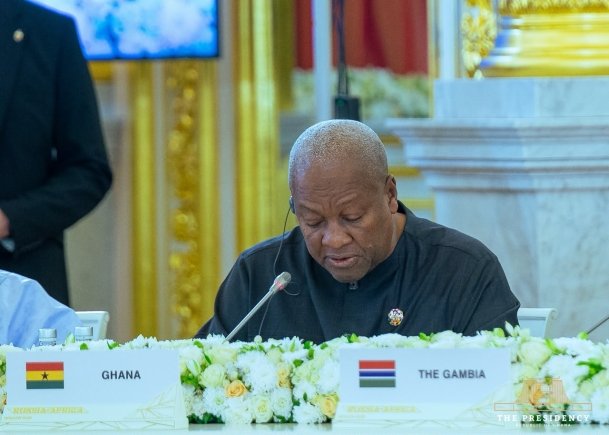
Ghana is pursuing nuclear power, and President John Dramani Mahama announced on Thursday, 29 October, that Accra has opened discussions with Russian state group Rosatom.
He spoke at the third Russia-Africa Summit in Moscow about Ghana’s civil nuclear programme.
For the president, the equation is simple: no industrialisation without reliable and affordable electricity.
According to Ghana News Agency, he said Russia has an advantage in nuclear as well as renewable energy two areas where the two partners can cooperate.
Ghana is not putting all its eggs in one basket. In April 2024, it signed a framework agreement with China’s CNNC for a Hualong One reactor of about 1,200 MW.
In August of the same year, Nuclear Power Ghana, the public body steering the programme, concluded a two-year agreement with US firm Regnum Technology Group, linked to NuScale technology, for small modular reactors totalling 924 MW.
The country aims for about 1,000 MW of operational nuclear capacity by 2034. According to the World Nuclear Association, Nsuban in the Western Region is the preferred site, with Obotan in the Central Region as the alternative.
The programme is at the second phase of the IAEA framework: site studies, institutional preparation, regulation and supplier negotiations. Construction falls under the third phase.
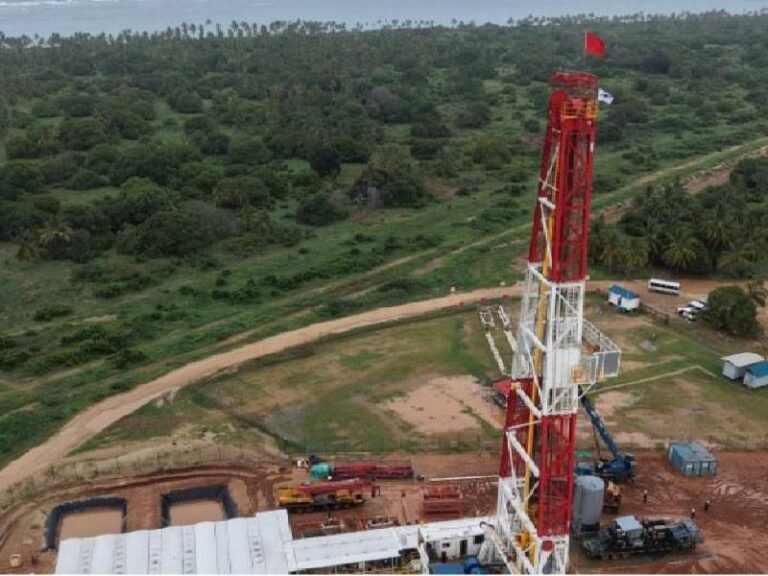
On the ground, work is advancing. In September, Environment, Science and Technology Minister Zanetor Agyeman-Rawlings reported that meteorological monitoring devices had been installed at the candidate sites, along with geographic checks and land acquisitions.
On skills, the School of Nuclear and Allied Sciences has already trained more than 800 master’s and doctoral graduates.
The country cooperates with the IAEA, the European Union, the United States, China, Japan, South Korea and Russia.
The major obstacle remains. In March, Stephen Yamoah, director-general of Nuclear Power Ghana, said detailed site studies and environmental impact assessments essential before any construction were unfunded.
By multiplying partners, Accra is giving itself the choice of the best offer. But between framework agreements and the first kilowatt-hour, financing will have to be secured. That is what will determine the credibility of Ghana’s nuclear ambition.
À propos de l'auteur