
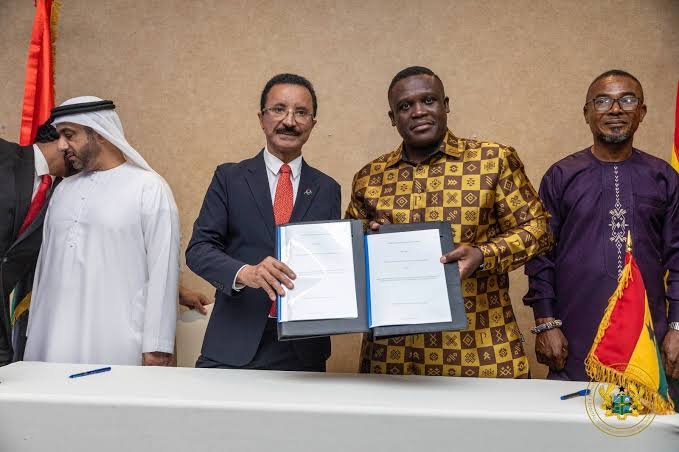
The memorandum of understanding signed between Ghana and Emirati investors, with an announced amount of $1 billion, fuels high ambitions: to create an innovation and technology hub capable of attracting more than 11,000 foreign companies. Presented as a lever for economic transformation, the project aims to make Ghana a gateway to West Africa for digital giants, start-ups, and high-value-added service companies.
On paper, the operation has all the makings of a winning bet. Ghana has been seeking for several years to diversify its economy, strengthen its attractiveness, and position itself as a regional hub of competitiveness.
Financial support from the United Arab Emirates, known for its investment strategy in infrastructure and technology, could accelerate this ambition. But behind the announcement, a key question remains: who will really benefit from this future ecosystem?
The first issue concerns skills transfer. Agreements of this type often promise training, mentorship, the creation of skilled jobs, and the rise of local talent.
Yet in practice, these mechanisms are sometimes limited to a few expatriate executives, while the majority of high-responsibility positions elude national actors.
Without clear obligations regarding recruitment, training, and co-management, there is a risk that the hub will operate as an economic enclave oriented more toward foreign interests than toward local development.
The place of Ghanaian talent will therefore be decisive. The country has a large youth population, dynamic universities, and a rapidly expanding entrepreneurial pool.
The project must still give them real access to financing, markets, and innovation networks. Otherwise, the hub could accentuate technological dependence rather than foster the emergence of African digital sovereignty.
This partnership will be judged not by the size of the announced investments, but by its capacity to create an inclusive economic fabric.
A technology hub can become an engine of growth. It can also, for lack of precise requirements, be nothing more than an attractive showcase serving external interests.
Everything will depend on how Ghana manages to impose its priorities, defend its talent, and transform this promise into a genuine transfer of economic power.
À propos de l'auteur