
Prime Minister Rimtalba Jean Emmanuel Ouédraogo on Tuesday, October 20, 2026, inaugurated the Bagré rice mill, an industrial unit managed by the state-owned company Faso Agropôles (SOFA). The commissioning, the third stage of his field visit, reflects the government’s determination to strengthen local processing of agricultural production in the service of food sovereignty.
Led by the Ministry of Agriculture, Water, Animal and Fisheries Resources and financed from the State’s own resources, the infrastructure is part of the 2026–2028 Agropastoral, Hydraulic and Fisheries Offensive.
With a processing capacity of 100 tonnes of paddy rice per day, it will strengthen processing capacity for actors in the sector.
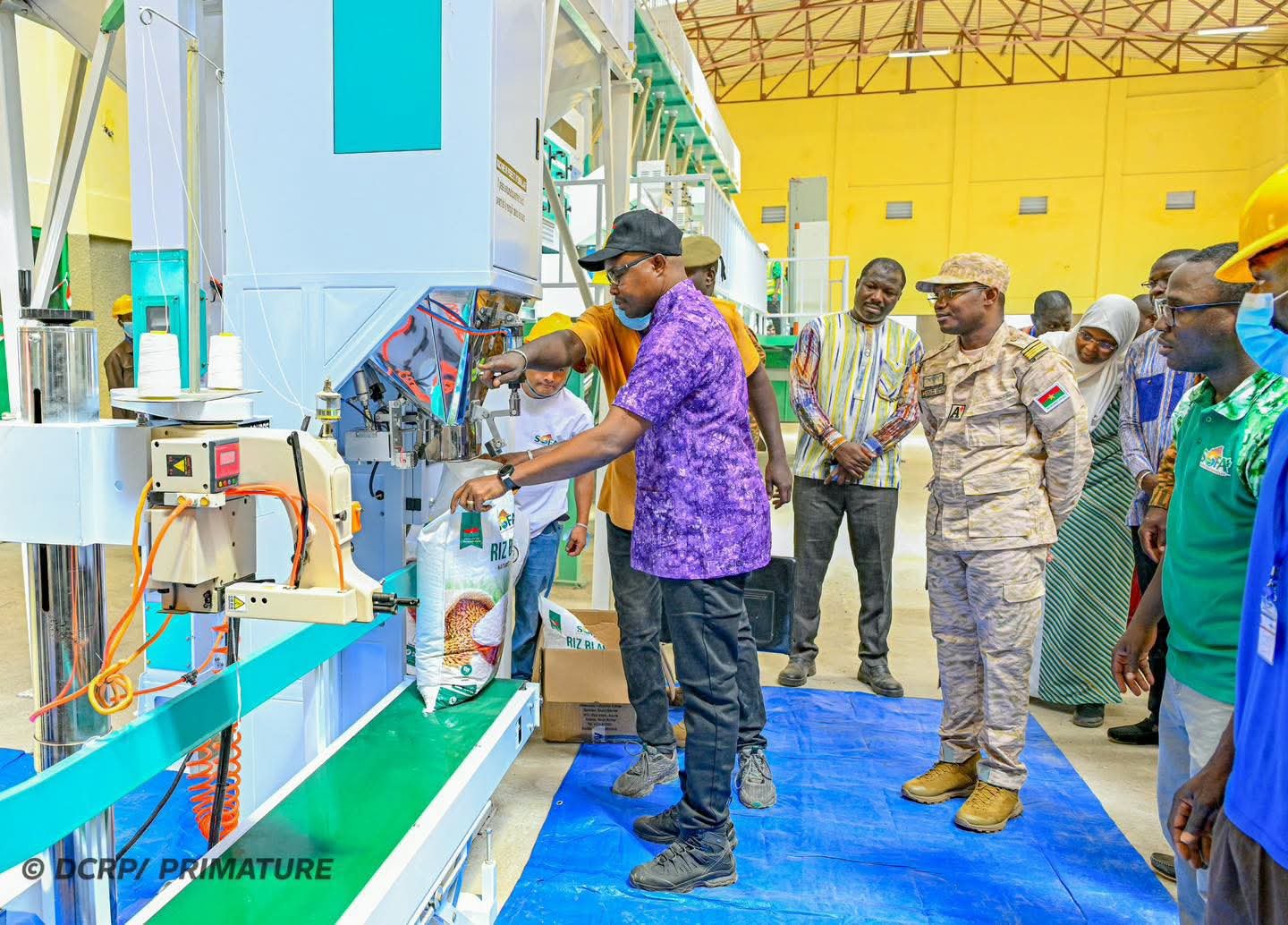
Guided by technical officials, the head of government toured a complete processing line, from cleaning paddy rice to packaging white rice.
The equipment removes impurities and foreign bodies; the huller removes the grain’s outer layer; a gravity separator distinguishes husked rice from remaining paddy; and whitening and water polishing complete the treatment.
The unit also has an optical sorter, a grader separating whole grains from broken grains, and storage, automatic weighing and bagging equipment.
These facilities are expected to improve the quality and market appeal of Burkinabe rice.
Beyond its technical performance, the rice mill meets a strategic need: facilitating the processing of paddy rice stocks built up by the State through farm-gate purchases.
It is intended to remove hulling constraints, better add value to harvests and consolidate outlets for local producers.
Addressing local populations, the Prime Minister stressed that the fight against imperialism also involves achieving food self-sufficiency. He recalled the vision of the President of Faso, Captain Ibrahim Traoré: linking production in the fields with industrial processing to create more added value.
He announced that industrial processing units will continue to be installed across the country and called on local populations to take ownership of the rice mill, while SOFA has the responsibility of ensuring its sustainable operation. In Bagré, the challenge now is to keep this public investment running in order to strengthen the place of Burkinabè rice in household diets.
À propos de l'auteur